
AI as a Design Partner
My Role: Lead Designer (Concept, graphics, AI-engagement, and content development)
Artifact Description
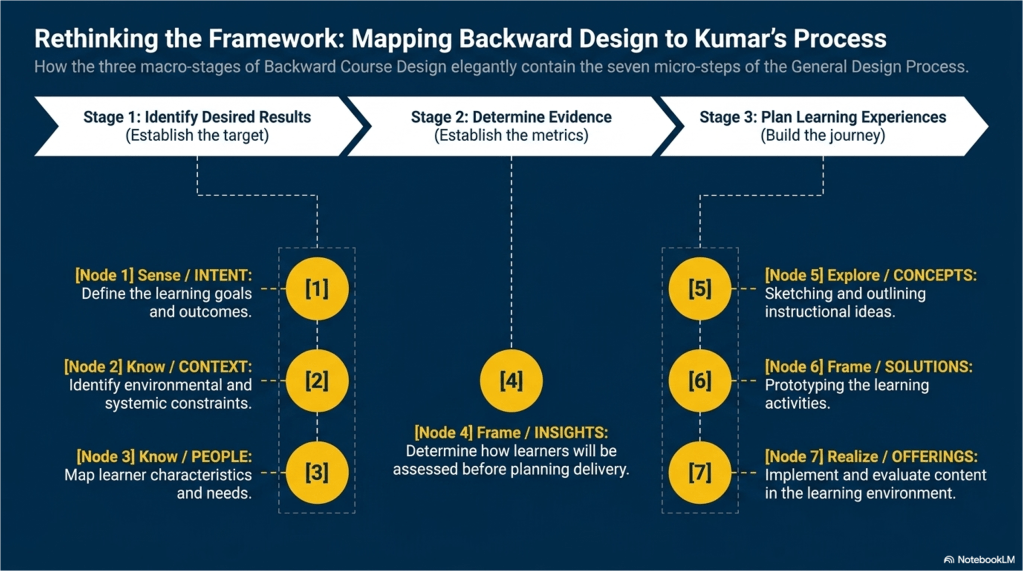
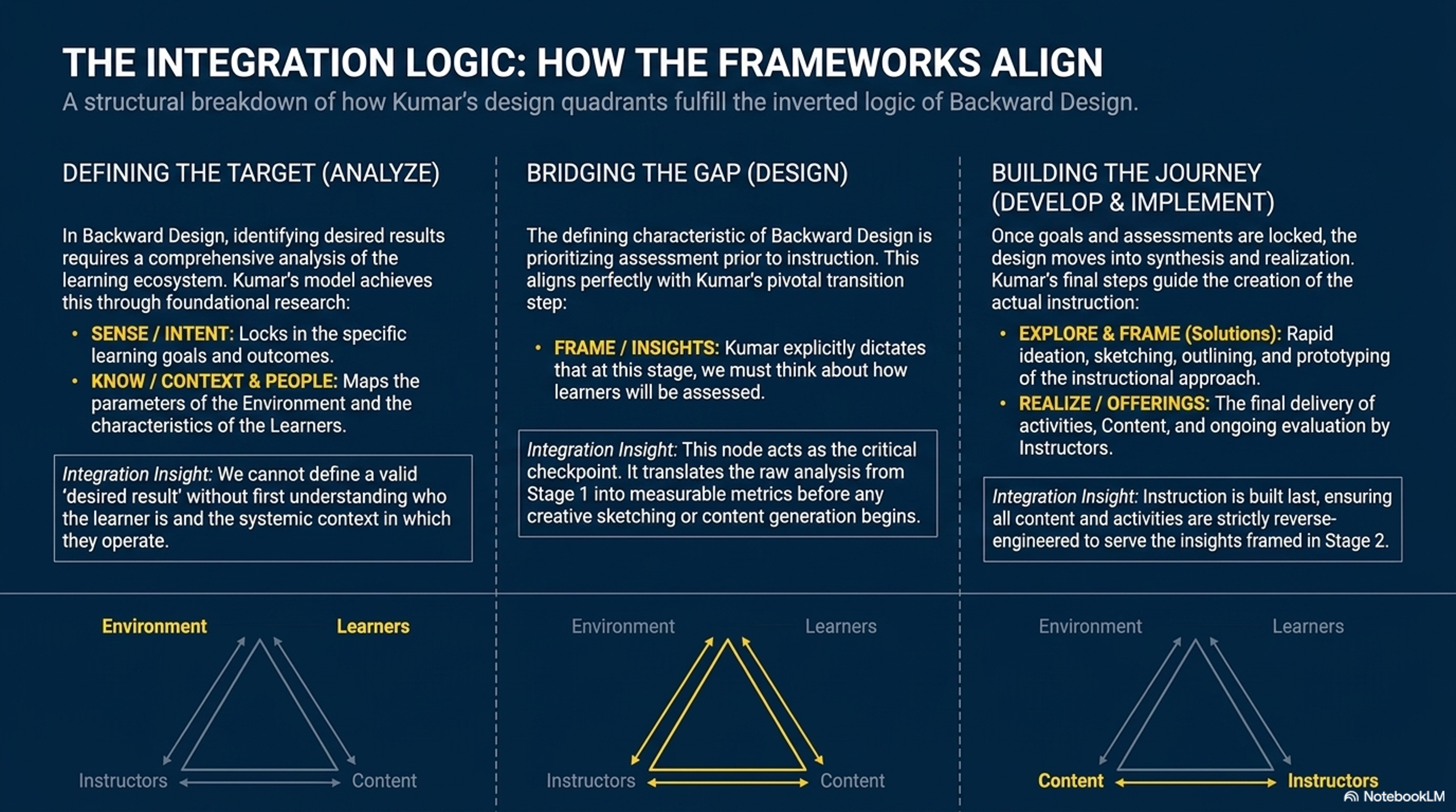
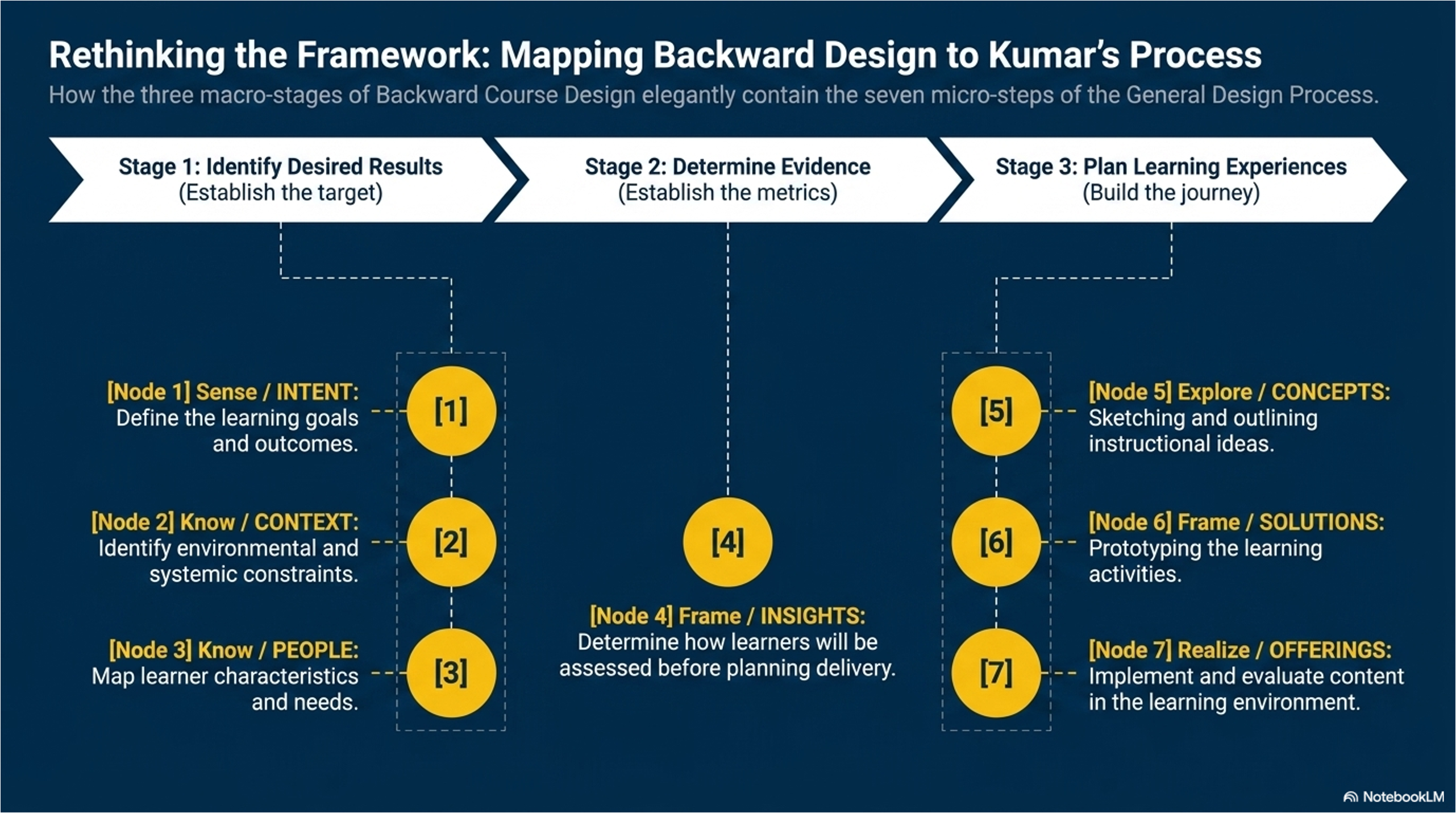
This artifact highlights my use of artificial intelligence (AI) in the design process. The artifact presents an AI-generated design map that helps novice Learning Experience Designers visualize the relationship between the Backward Design framework and Kumar’s seven nodes. The image places Kumar’s nodes within the three stages of Backward Design: Identify Desired Results, Determine Evidence, and Plan Learning Experiences. This approach clarifies how the two processes align conceptually.
The project demonstrates how generative AI can efficiently break down complex instructional frameworks for educators and learners. With effective prompts, LXDs can use AI to visualize processes, compare frameworks, and quickly assess design strengths and gaps. This enhances understanding while maintaining critical thinking and design rigor.
Citation: Kumar, V. (2012). 101 Design Methods: A Structured Approach for Driving Innovation in Your Organization. Wiley.
Artifact
Drag the ruler over the image to compare the first AI-generated image of the process map with the final product. Through a process of refinement and strategic prompts, the design team used feedback and research to develop an informative, effective AI-generated instructional aid.
More Information
Case Study Fast Facts
- Project Goals — Create a clear, accessible visual map that helps novice LXDs understand the relationship between the Backward Design framework and Kumar’s seven nodes
- Target Audience — Learners and early‑career LXDs developing foundational skills in instructional design, design thinking, and framework evaluation across disciplines and settings
- Problem Statement — Learners often struggle to see how different design frameworks align conceptually. Without a structured comparison, they may treat Backward Design and Kumar’s nodes as unrelated processes, leading to confusion and inconsistent application.
- Challenges Overcome — Required simplifying two complex frameworks without oversimplifying their intent, maintaining conceptual accuracy, and ensuring the visuals were intuitive for the audience
- Instructional Design Process — Identified conceptual overlaps, drafted early framework comparisons, and refined the mapping through multiple AI‑assisted prototypes using an iterative, analysis‑first approach. Feedback loops ensured clarity, accuracy, and instructional usefulness.
- Design Solution — An AI‑generated map that nests Kumar’s 7 nodes within Backward Design’s 3 stages, highlighting how the two models complement one another
- Tools and Approach — Used generative AI (Copilot, Grammarly, and Notebook LM) to rapidly prototype visual maps, compare framework structures, and refine conceptual alignment. Leveraged AI‑assisted prompts to generate multiple iterations, evaluate clarity, and select the most effective representation. Applied principles of visual hierarchy and concept mapping to ensure the final artifact supported novice learners’ understanding.
- Evaluation and Impact — Collected learner feedback and informal performance indicators showing increased confidence, clearer understanding of research steps, and improved ability to begin research tasks independently
- Reflection — Gained insight into designing for mixed‑motivation learners; learned to streamline content under tight timelines; would incorporate more learner testing in future iterations
- Conclusion — The final solution improved learner clarity and confidence, demonstrated effective use of multimedia learning principles, and showcased a scalable approach to foundational research instruction

