
Creating Learner Centered Designs with AI Insights
My Role: Design Partner (Concept, graphics, AI-workflow developer, SME consultant, and content development)
Artifact Description
This project showcases how AI‑generated learner personas were developed to guide the redesign of a required general education course. The goal was to create a data‑driven, learner‑centered foundation for instructional design decisions. This enhances the instructor’s ability to deliver the course in a way that meaningfully supports the diverse student population being served.
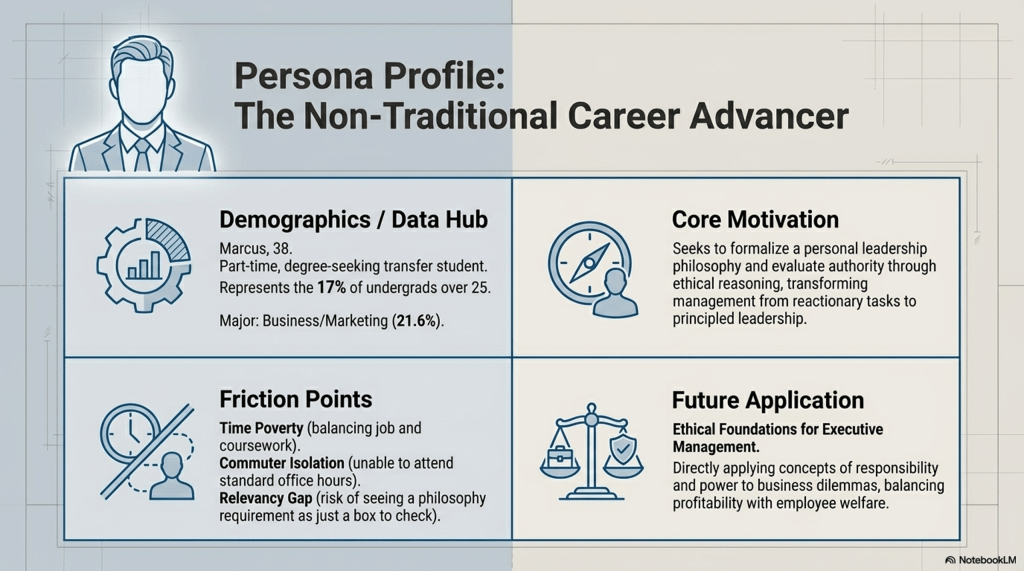
The personas were generated using institutional data, barrier analysis, and contextualized application mapping drawn directly from the university’s Common Data Set and course enrollment demographics. The design process began by analyzing institutional data to create three representative learner personas.
Artifact
These images provide a glimpse into both the product and process used to create AI-generated learner personas for the course. Through a process of refinement and strategic prompts, the design team used data and SME insights to develop learner profiles that grounded the design process and aided decision-making.
Title slide for “Philosophy of Leadership Course: Learner Personas” featuring a compass rose overlaid on a blueprint of a building. 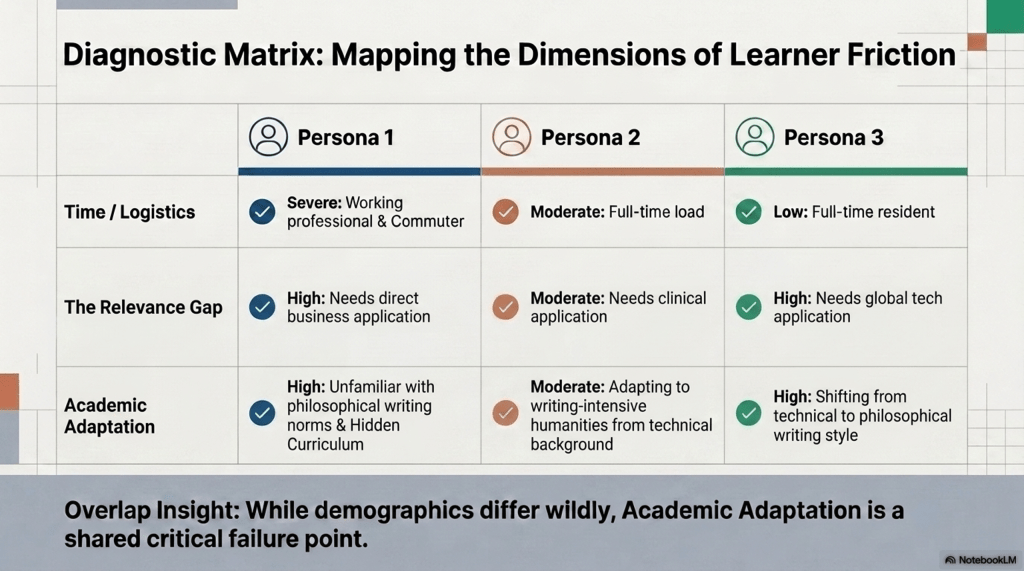
A visual comparison of learner friction across time, relevance, and academic adaptation. Marcus’s profile illustrating the challenges and motivations of working adult learners. 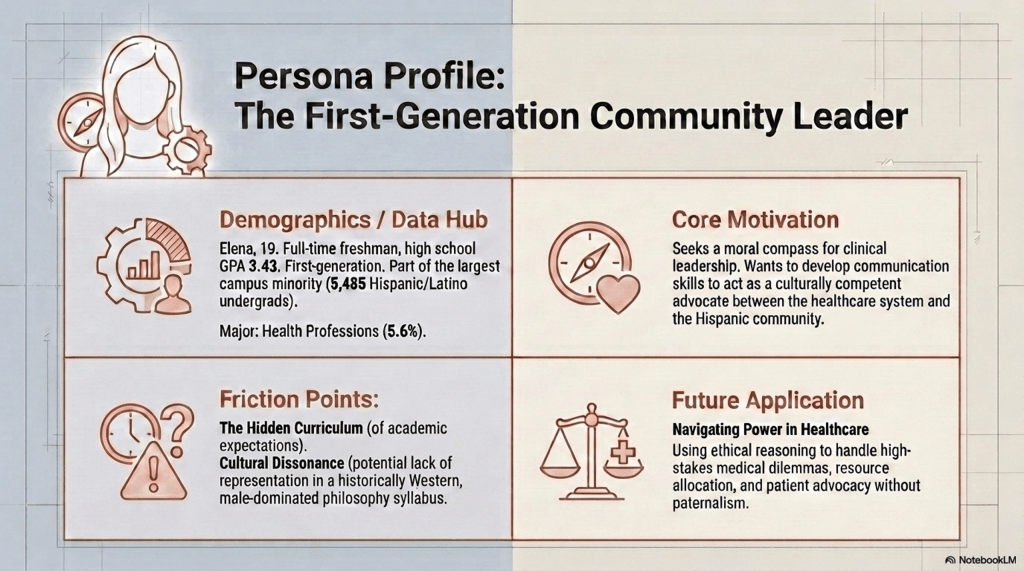
Elena’s story highlighting first‑generation student experiences and cultural leadership goals. 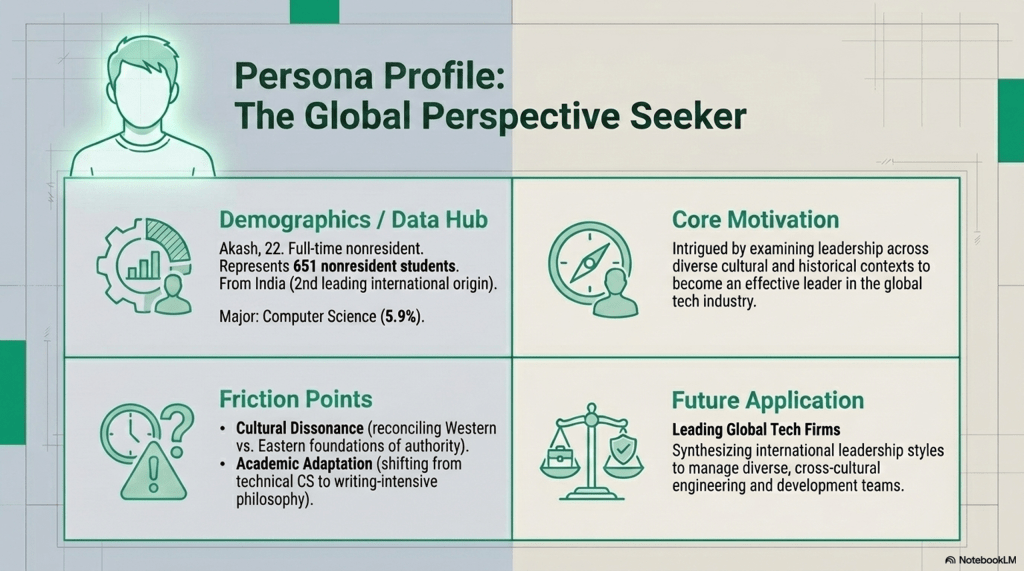
Akash’s journey showing how international students navigate cross‑cultural leadership. 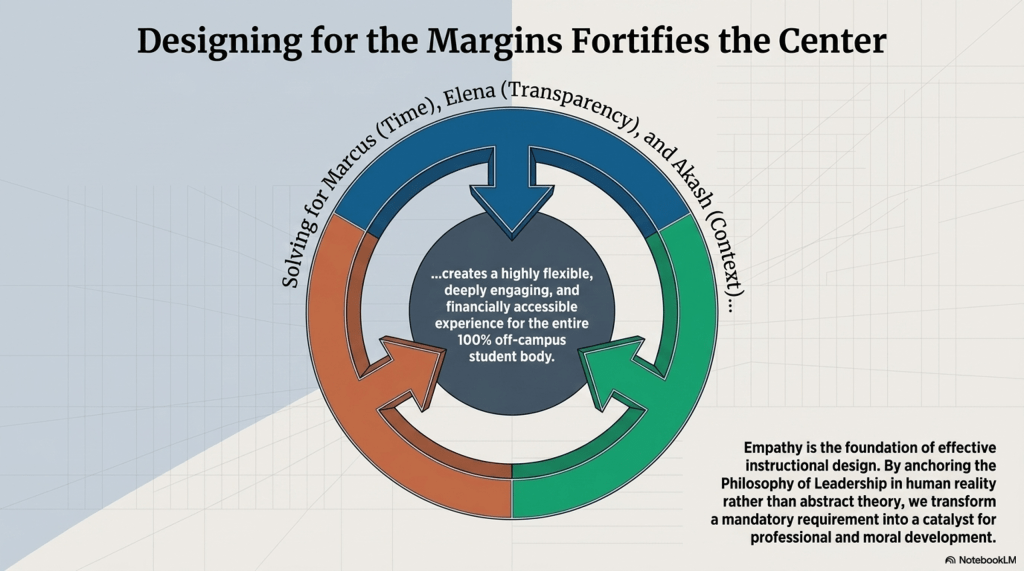
A model demonstrating how solving for edge‑case learners improves learning for everyone. 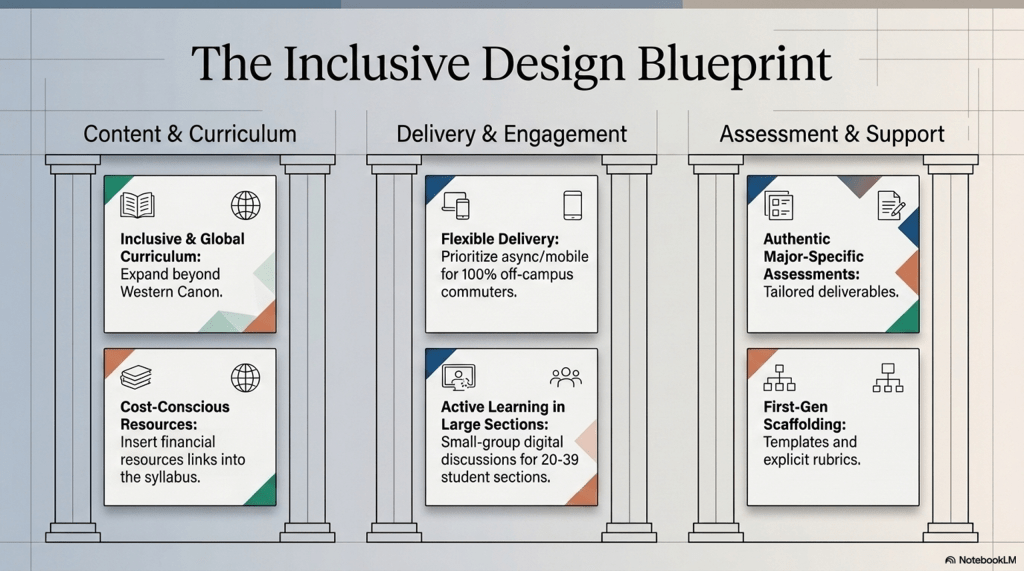
Three pillars outlining equitable curriculum, delivery, and assessment practices. 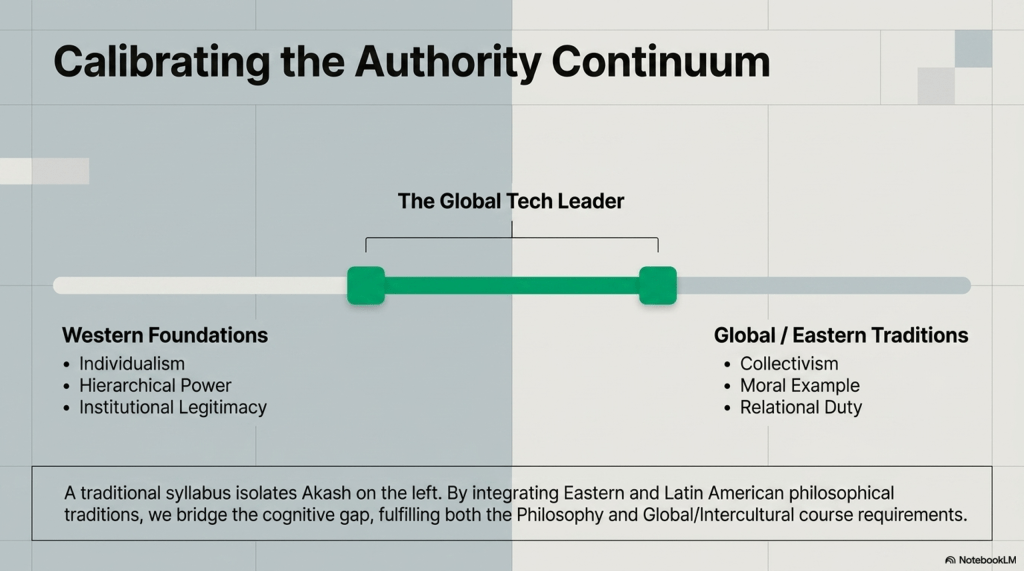
A continuum mapping Western and Eastern leadership philosophies for global readiness. 
A staircase showing how transparency and scaffolding support academic success. 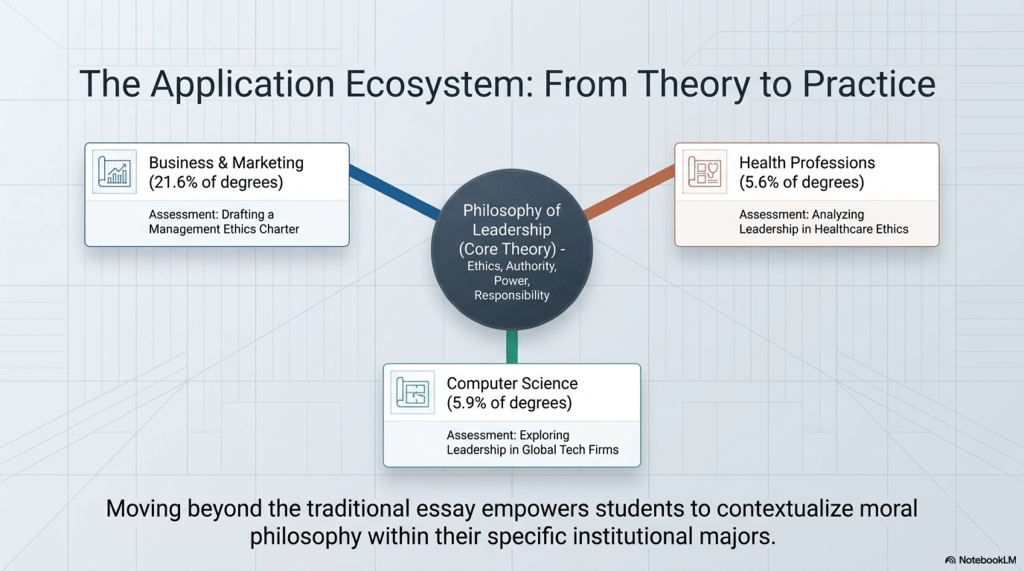
A diagram connecting leadership philosophy to major‑specific, real‑world assessments.
More Information
Case Study Fast Facts
1. Data‑Driven Persona Generation
Institutional data was translated into 3 representative learner profiles. These personas reflect real demographic patterns, academic pathways, and lived experiences of prospective students.
- Marcus — The Working Professional
- Elena — The First‑Generation Leader
- Akash — The Global Perspective Seeker
Each persona was generated using AI visualization tools to create a compelling, humanized representation of the learners the course is designed to serve.
2. Barrier & Needs Analysis
After establishing the personas, the next step was identifying the barriers that shape their learning experience. The analysis highlighted several key obstacles:
- Logistical Barriers — “Time poverty” for working professionals and “commuter isolation,” given that 100% of undergraduates live off‑campus.
- Academic & Cultural Barriers — First‑generation students face the “hidden curriculum,” while international students navigate “cultural dissonance” when encountering Western philosophical frameworks.
These insights directly informed the design strategies and course structure.
The Human Touch
While the AI analysis also identified financial constraints as a learning barrier, the instructor and the design team decided that addressing that issue was beyond the scope of the course. Therefore, they decided to include links to financial resources in the syllabus rather than adding financial content to the learning modules.
3. Contextualized Application Mapping
To ensure that concepts felt relevant and actionable, each persona was mapped to career‑specific applications of ethical reasoning, authority, and leadership. Examples include:
- Marcus applying ethical decision‑making to management scenarios
- Elena connecting theories of responsibility to clinical leadership
- Akash exploring global tech ethics and cross‑cultural authority structures
This mapping ensured the course moved beyond abstract theory and into authentic, discipline‑aligned practice.
4. Inclusive Design Strategy
The final stage translated persona insights into evidence‑based design decisions. Specific design strategies were identified to support authentic, accessible, and culturally responsive course design. Key strategies included:
- Authentic Assessment — Replacing generic essays with major‑specific projects such as a Management Ethics Charter or global tech leadership analysis
- Asynchronous Delivery — Prioritizing mobile‑friendly, flexible content for a commuter‑heavy population
- Globalized Curriculum — Expanding beyond the Western Canon to include Eastern and Latin American philosophical traditions
- Scaffolded Success — Using templates, rubrics, and financial resource connections to reduce barriers
Conclusion
These AI‑generated personas served as the backbone of a learner‑centered process. By grounding the course in real demographic data, authentic learner needs, and inclusive design principles, the project demonstrates how AI visualization–when partnered with human insight–can enhance empathy, clarity, and intentionality in instructional design.
 Laux Portfolio