
Process, Theories, Frameworks, and Accessibility
My Role: Lead Designer (Team lead, research and analysis, graphics, AI-engagement, SME, & content development)
Artifact Description
This artifact highlights a sample design process, a sample instructional activity, and my ability to create accessible materials. The activity–entitled Evaluating Sources–uses a structured framework to develop learners’ abilities to evaluate academic sources, apply practical decision-making, and build digital literacy.
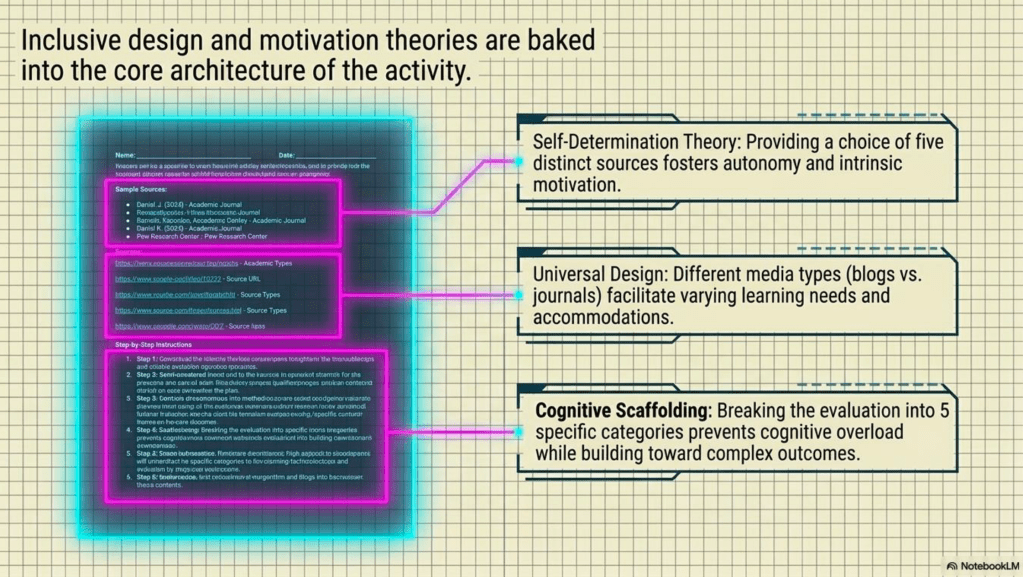
The activity integrates several design theories and frameworks, including Backward Design, Universal Design for Learning, Scaffolding, Bloom’s Taxonomy, Formative Assessment, Motivation Theory, Self-determination Theory, and Inclusive Design. Artificial intelligence (AI) was utilized to document the process, improve accessibility, and help stakeholders understand the theories and frameworks behind our recommendations.
Artifacts
Artifact #1: Instructional Activity
Artifact #2: Theory & Framework Outline
Artifact #3: Design Process Presentation
More Information
Case Study Fast Facts
Artifact #1: Instructional Activity
The “Evaluating Sources” activity was designed for undergraduate students at a four-year institution. It uses a structured framework to help students evaluate academic sources, make informed decisions, and strengthen digital literacy. Students select a source and analyze it using the CRAAP Test, a recognized method for assessing scholarly credibility. For each criterion, students write a two-sentence evaluation and decide whether the source is academically acceptable.
Artificat #2: Theory & Framework Outline
The theory and framework outline showcases how the Evaluating Sources activity was designed using Backward Design, Bloom’s Taxonomy, scaffolding, and UDL to build learners’ critical thinking and source‑evaluation skills. By offering multiple source types, emphasizing learner autonomy, and using formative assessment, the design supports diverse learners while strengthening analytical reasoning. Overall, the document demonstrates how theory‑driven design decisions create structured, accessible, and pedagogically aligned learning experiences.
Artifact #3: Design Process Presentation
The design process presentation is a compilation of materials that were used to communicate with and support SMEs and other stakeholders throughout the design process. The presentation shows how the activity evolved from an initial concept to a fully aligned instructional resource. It demonstrates multiple LXD competencies by applying different theories and frameworks, visualizing design decisions at each stage, and highlighting how clear conceptual products support stakeholder alignment. The artifact also demonstrates the use of generative AI to visualize and document the design process for stakeholders. AI was also used to develop alternative text and conduct accessibility checks on all documents and presentation materials.

